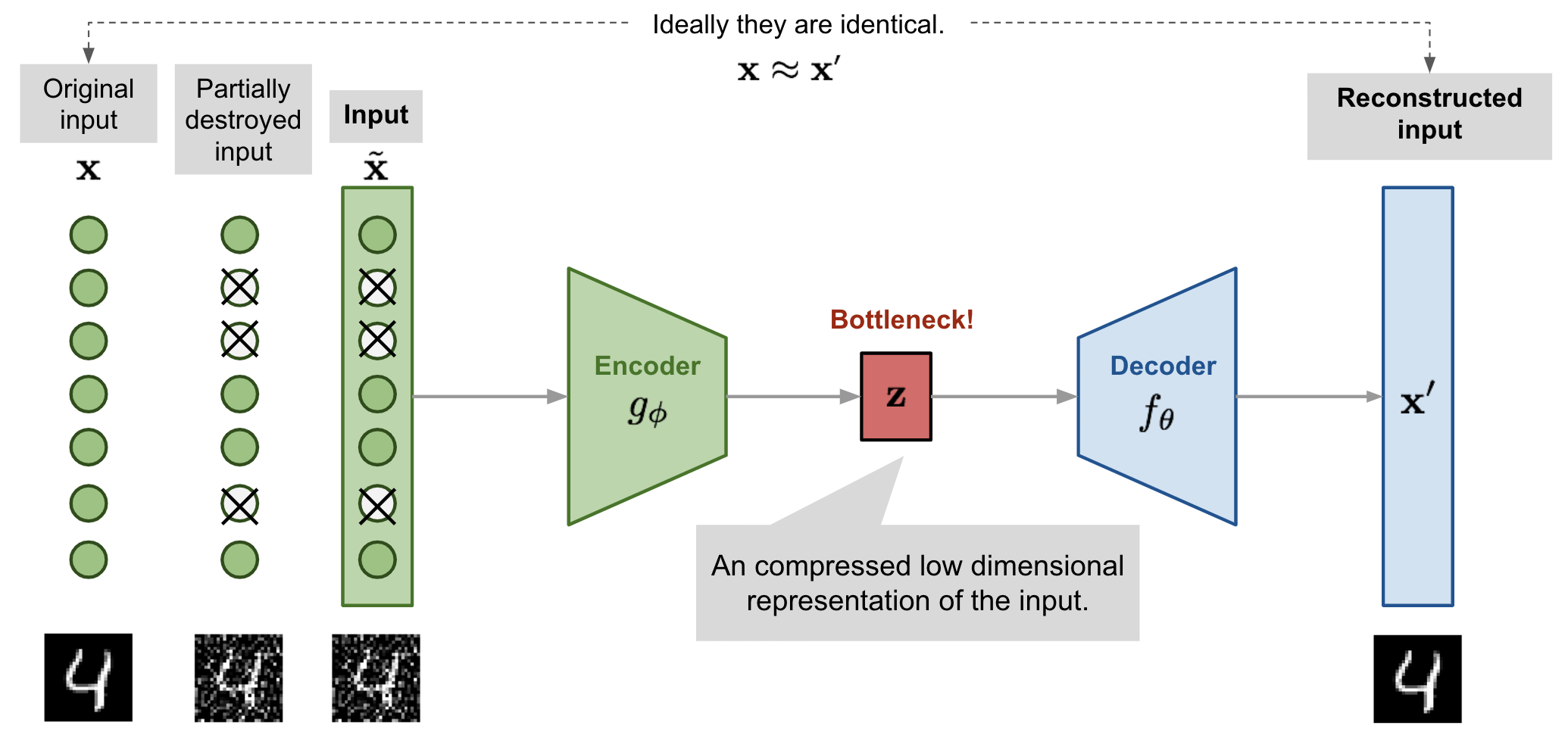
What is a Denoising Autoencoder?
The Denoising Autoencoder is a modification to the basic autoencoder.
The denoising autoencoder partially corrupts the initial input vector x in a stochastic manner:
x~(i)∼MD(x~(i)∣x(i))
The model is then trained to recover the original input by minimizing:
LDAE(θ,ϕ)=n1∑i=1n(x(i)−fθ(gϕ(x~(i))))2
where MD defines the mapping from the true data samples to the noisy or corrupted ones.
Machine Learning Research
Flashcards is a collection of flashcards associated with scientific
research papers in the field of machine learning. Best used with Anki or Obsidian.
Edit MLRF on GitHub.