Denoising Diffusion Probabilistic Models
Give the forward diffusion process.
Given a data point sampled from a real data distribution , let us define a forward diffusion process in which we add small amounts of Gaussian noise to the sample in steps, producing a sequence of noisy samples . The step sizes are controlled by a variance schedule
As , becomes equivalent to an isotropic Gaussian distribution.
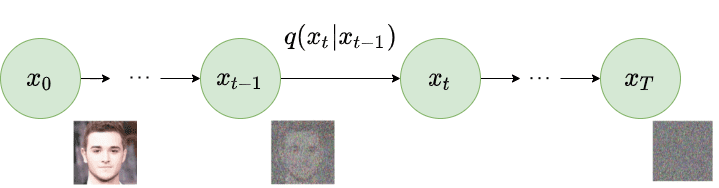 Forward diffusion process. Image modified by Ho et al. 2020
Why is the mean of the forward diffusion model scaled by , where is the variance to ?
The scaling factor is needed to avoid making the variance of grow in each step. If we would not scale it, after steps we will have a value . To force we need to scale by .
In the forward diffusion process, how can we go from to in a single step ? Recall that
Using the reparameterization trick that tells us: and (where , Reparameterization trick).
If we define and , then by recursively applying this trick:
Therefore:
Note: When merging two Gaussians and , the result is . Thus .
Draw the diffusion process.
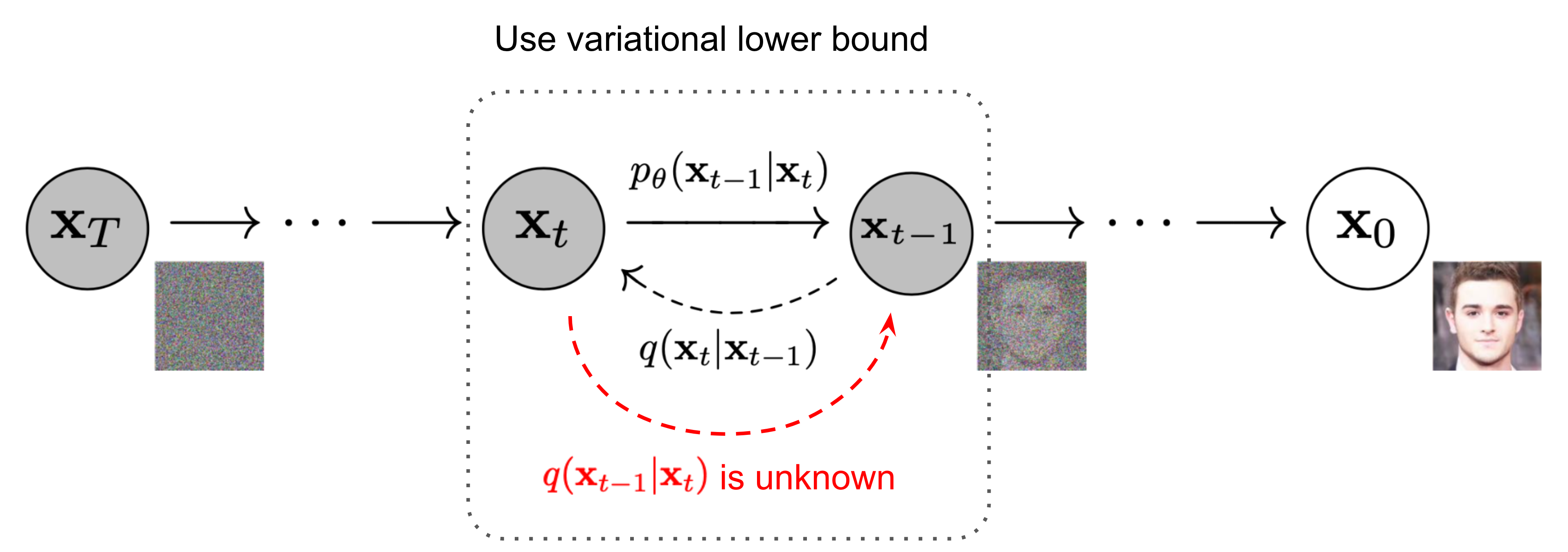
Give the simplified objective funtion (loss) for diffusion models.
where is a constant not depending on .
The time-dependent loss is:
Substituting :
Give the training algorithm for Denoising Diffusion Probabilistic Models.
repeat until convergence: Take gradient descent step on
Give the inference algorithm for Denoising Diffusion Probabilistic Models.
for do: if , else return