High-Resolution Image Synthesis with Latent Diffusion Models
Give an overview of the Latent Diffusion Model (Stable Diffusion architecture).
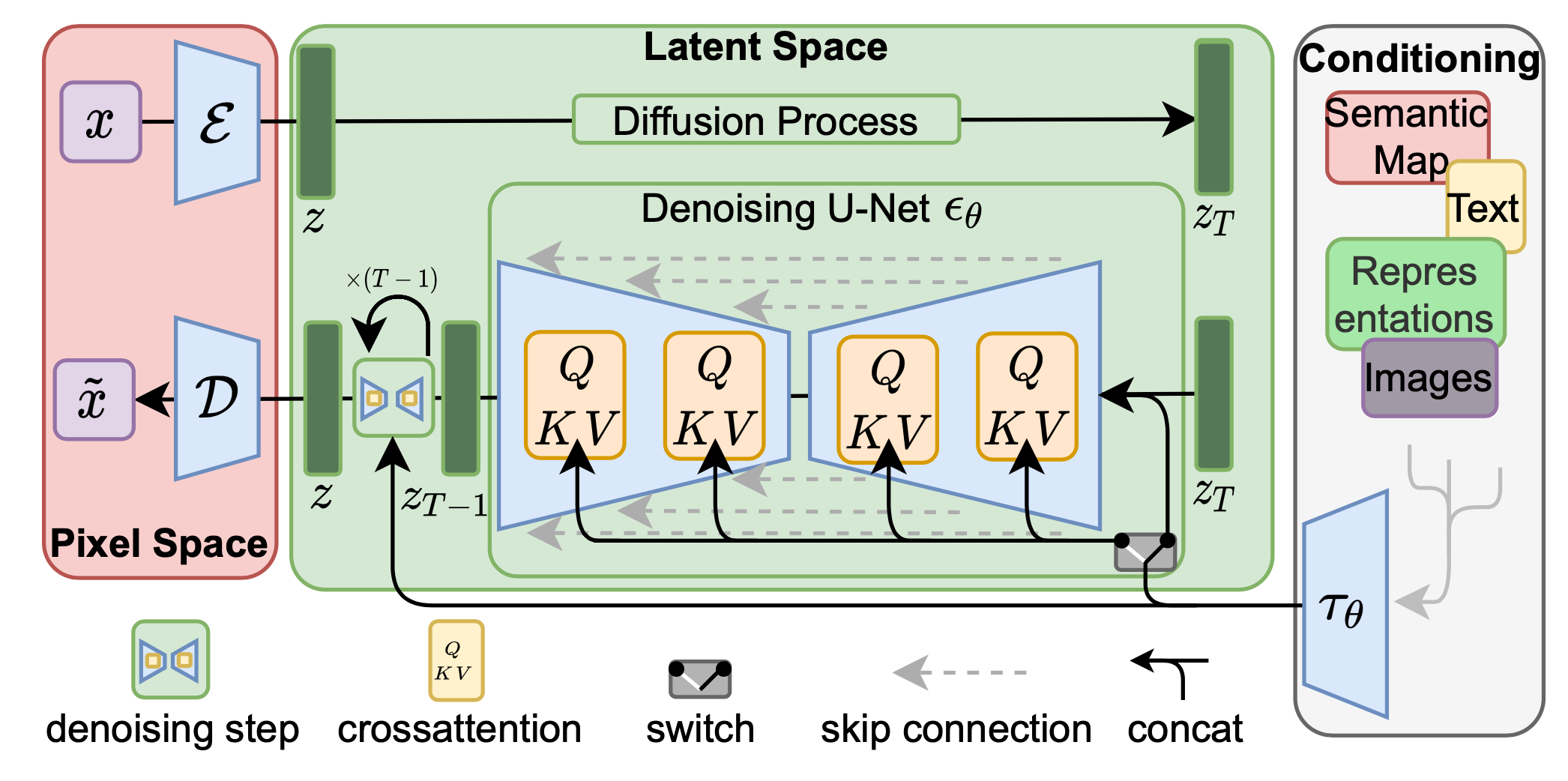 An encoder is used to compress the input image to a smaller 2D latent vector , where the downsampling rate . A decoder reconstructs the images from the latent vector: .
The diffusion and denoising processes happen on the latent vector .
The denoising model is a time-conditioned U-Net, augmented with the cross-attention mechanism to handle flexible conditioning information for image generation.
To process from various modalities, a domain specific encoder that projects to an intermediate representation is used.
An encoder is used to compress the input image to a smaller 2D latent vector , where the downsampling rate . A decoder reconstructs the images from the latent vector: .
The diffusion and denoising processes happen on the latent vector .
The denoising model is a time-conditioned U-Net, augmented with the cross-attention mechanism to handle flexible conditioning information for image generation.
To process from various modalities, a domain specific encoder that projects to an intermediate representation is used.
The cross-attention mechanism is defined as:
where the projections are:
with dimensions:
where denotes a (flattened) intermediate representation of the UNet implementation .
How is the latent diffusion model trained?
The compression part (e.g. encoder and decoder ) and diffusion part are trained in different phases (first compression then diffusion).
Usually the compression part is taken from a pretrained network such as CLIP.
How does the latent diffusion model avoid arbitratily high-variance latent spaces?
It proposes two variants to deal with this:
- KL-reg: a small Kullback-Leibler penalty is imposed towards a standard normal distribution over the learned latent, similar to a VAE.
- VQ-reg: a vector quantization layer is used within the decoder, similar to VQVAE but the quantization layer is absorbed by the decoder.